×
× 




Unit 10 Tiếng Anh lớp 8 về chủ đề Communication in the future giúp các bạn học sinh tìm hiểu về các phương thức giao tiếp tương lai. Các bài học được biên soạn giúp các bạn học sinh trau dồi vốn từ vựng và ngữ pháp, đồng thời rèn luyện các kỹ năng Tiếng Anh.
Trong bài viết này, IELTS LangGo sẽ cung cấp đáp án và hướng dẫn trả lời cho tất cả các phần, giúp các bạn nắm vững nội dung bài học để vận dụng hiệu quả trong các bài kiểm tra cũng như trong giao tiếp thực tế.
Phần Listen and Read là đoạn hội thoại giữa Mark và Trang tại câu lạc bộ công nghệ giúp các bạn làm quen với các từ vựng về thiết bị công nghệ và các hình thức giao tiếp hiện đại.
Đáp án:
1. What are Trang and Mark doing?
→ A. Practising a video call.
2. What device does Trang need help with?
→ C. The webcam.
3. Mark says that they should ______ in the future.
→ A. have more video conferences
Đáp án:
1 - d: tablet
2 - a: webcam
3 - b: zoom in
4 - e: video conference
5 - c: Internet connection
1. Our English exam was a piece of cake. I got full marks on it.
→ A. easy
2. You're kidding! I can't believe Ms Mai and you are sisters.
→ B. joking
3. I can't read the text on the computer screen. Can you zoom in on it?
→ A. make it bigger
4. We need a high-speed Internet connection to make video calls.
→ A. fast
5. That's exactly how I feel. It's true that video conferences are very convenient.
→ B. You are absolutely right.
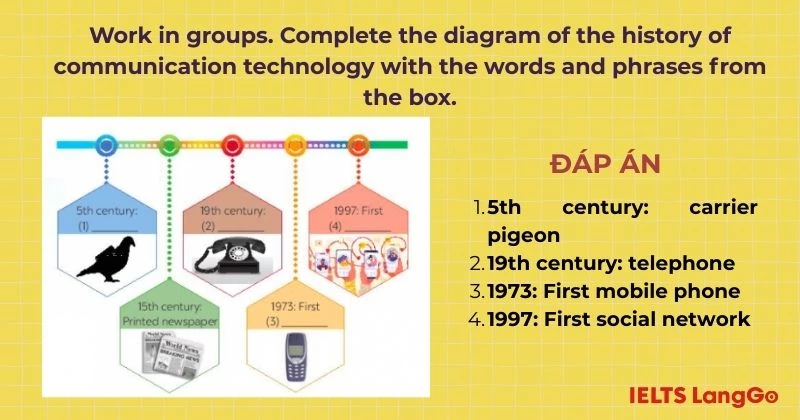
Đáp án:
1. 5th century: carrier pigeon
2. 19th century: telephone
3. 1973: First mobile phone
4. 1997: First social network
>> Xem chi tiết hướng dẫn giải tại đây: Tiếng Anh 8 Unit 10 Getting Started
Phần bài học này giúp các bạn học sinh mở rộng vốn từ vựng về các hình thức giao tiếp hiện đại và luyện tập quy tắc trọng âm đối với các từ có hậu tố -ese và -ee.
Đáp án:
Hình (1) - smartphone
Hình (2) - emojis
Hình (3) - voice message
Hình (4) - holography
Hình (5) - social network
Hình (6) - group call
1. Many people add ______ to their text messages to express their feelings.
→ A. emojis
2. I send ______ messages when I don't feel like typing.
→ C. voice
3. Many teenagers like to meet on social ______ rather than face to face.
→ B. networks
4. In a ______, people in different places can join the conversation.
→ B. group call
5. By using ______, you can attend a meeting with your 3D image instead of being there in person.
→ A. holography
Đáp án:
1. Do you often send private messages to your friends?
2. Can learning English help you overcome the language barrier when living abroad?
3. Telephone helps you communicate in real time.
4. Do you think translators will lose their jobs when translation machines become popular?
5. Many people reply to messages instantly, but others take a long time to respond.
| -ese | -ee |
| Chinese - /ˌtʃaɪˈniːz/ | agree - /əˈɡriː/ |
| Bhutanese - /ˌbuː.təˈniːz/ | trainee - /ˌtreɪˈniː/ |
| Japanese - /ˌdʒæp.ənˈiːz/ | awardee - /ˌɔː.wɔːˈdiː/ |
| Taiwanese - /ˌtaɪ.wəˈniːz/ | interviewee - /ˌɪn.tə.vjuˈiː/ |
| Vietnamese - /ˌvjet.nəˈmiːz/ | guarantee - /ˌɡær.ənˈtiː/ |
Đáp án:
1. The interviewees said that they were Taiwanese.
2. Joe agrees with me that learning Chinese is difficult.
3. She obtained a bachelor's degree in Japanese.
4. The Taiwanese company gave each awardee a smartphone.
5. The Japanese teacher sent a video to the absentees on Monday.
>> Xem chi tiết hướng dẫn giải tại đây: Tiếng Anh 8 Unit 10 A Closer Look 1
Phần này tập trung vào 2 chủ điểm ngữ pháp quan trọng: Giới từ chỉ nơi chốn và thời gian (Prepositions of place and time) và Đại từ sở hữu (Possessive pronouns).
Đáp án:
1. Lily's house is at the end of this street.
2. Players always sit opposite each other in a chess game.
3. She looked under the table and finally found her smartwatch.
4. Don't walk on the street. Walk on the pavement.
5. Ann stood in front of me in a line to get on the bus.
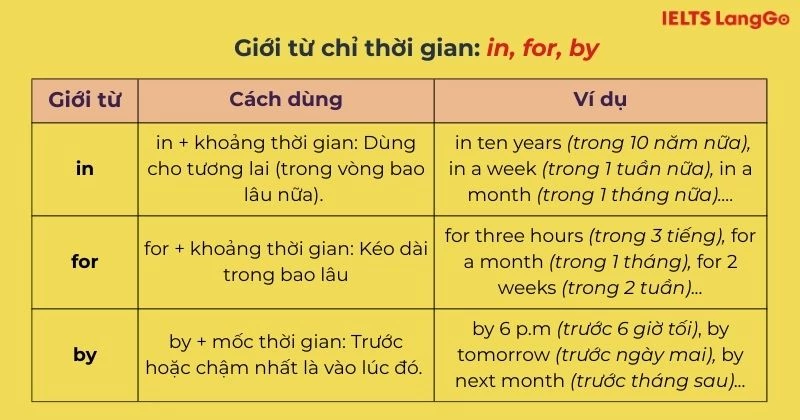
Đáp án:
1. Let's get ready by / on / for 10 a.m. We are meeting Dr Saito at 10:15.
→ Đáp án: by
2. The first camera phone appeared on / at / in May 1999 in Japan.
→ Đáp án: in
3. We will be away on / for / by two weeks.
→ Đáp án: for
4. In the UK, supermarkets always close early in / by / on Sundays.
→ Đáp án: on
5. I think language barriers will disappear in / for / by 30 years.
→ Đáp án: in
Đáp án:
I think smartphones will change a lot (1) in the near future. They will be much thinner. (2) By 2035, we might be able to roll a phone like a sheet of paper. They will become much smarter, too. They will be able to charge their battery automatically when we are (3) at home. They might check the latest news (4) on the Internet. We won't have to wait (5) for a long time for these super smartphones.
TOPIC 1: We should not use our smartphones for more than a few hours every day.
Gợi ý trả lời:
I agree that we should not use our smartphones for more than a few hours every day. Using smartphones too much is bad for our eyes and health. It can also make us tired and addicted. Instead of spending too much time on phones, we should study, exercise, and communicate with people face to face.
I disagree with this idea because smartphones are very useful in our daily lives. We use them to study, communicate with friends, and find information. If we use smartphones in a smart way, using them for many hours a day is not a problem.
TOPIC 2: By 2050, the way people communicate with each other will be different from now.
Gợi ý trả lời:
I agree that by 2050, the way people communicate with each other will be different from now. In the future, people may use more video calls, social media, and smart devices to communicate. Technology will play an important role and change the way people talk to each other.
I disagree with this idea because face-to-face communication will always be important. Although technology develops, people still like to meet and talk to each other in person. Some ways of communication may change, but basic communication will remain the same.
Đáp án:
1. Jack is one of her cousins.
→ Jack is a cousin of hers.
2. Is this one of his tablets?
→ Is this a tablet of his?
3. Can I borrow a pencil of yours?
→ Can I borrow one of your pencils?
4. You look like Nick and Peter. Are you one of their relatives?
→ Are you a relative of theirs?
5. Last year, two of our classmates won scholarships to the US.
→ Last year, two classmates of ours won scholarships to the US.
>> Xem lời giải chi tiết tại đây: Tiếng Anh lớp 8 Unit 10 A Closer Look 2
Phần này giúp học sinh nắm được cách ngắt lời người khác một cách lịch sự, đồng thời luyện kỹ năng giao tiếp về chủ đề Communication in the future thông qua các bài tập và thực hành hội thoại.
Hội thoại 1:
Mark: Now, about the video conference... Everyone must be here at 9:30 a.m., and …
Trang: Sorry for interrupting, but I think we should meet at 9:00 a.m. We need to test the devices.
Hội thoại 2:
Nick: This webcam is easy to handle. You click these buttons to move it up or down and these to …
Lan: Hold on. Can you repeat that, please?
Tình huống 1: Student A is telling student B how to make a video call. Student B interrupts student A to ask for clarification.
Gợi ý hội thoại:
Student A: First, you open the application, then you select the contact you want to call and press the camera icon…
Student B: Hold on. Which application should I open?
Student A: Oh, open Skype or Zoom.
Tình huống 2: Student A is telling student B the place for their next meeting. Student B interrupts student A to suggest another place.
Gợi ý hội thoại:
Student A: So, for our group project meeting next week, let's gather at the school library…
Student B: Sorry for interrupting, but the library is often very crowded and noisy in the afternoon. How about the canteen?
Đáp án:
1. What means of communication is Mark talking about?
→ Mark is talking about emojis.
2. When will emojis become more commonly used?
→ In 20 years.
3. Who will be using them?
→ People of all ages.
4. How will they help in communication?
→ They help people communicate their emotions effectively regardless of the language they speak.
5. Why will they become more popular?
→ Because an emoji can replace words to a certain extent, for example, a smiley face expresses the same meaning everywhere.
Hội thoại mẫu về Automatic translation function:
A: Which means of communication do you think will be popular?
B: I think the automatic translation function will be very popular.
A: When will it become popular?
B: Probably in 10 years.
A: Who will be using it?
B: Social network users will use it a lot.
A: How will it help in communication?
B: It will translate comments and private messages in all languages.
A: Why will it become popular?
B: Because it helps remove language barriers.
Hội thoại mẫu về Chatbot:
A: Which means of communication do you think will be popular?
B: I think chatbots will be very popular.
A: When will they become popular?
B: Probably in 10 years.
A: Who will be using them?
B: Sellers of online shops will use them a lot.
A: How will they help in communication?
B: They will instantly reply to customers in all languages.
A: Why will they become popular?
B: Because they help sellers sell more products to customers from other countries.
Bài mẫu về Automatic translation function:
The automatic translation function is expected to become very popular in the future. In particular, it will probably be widely used in about 10 years. Moreover, this function will be mainly used by social network users. Thanks to this technology, it can translate comments and private messages into all languages instantly. As a result, people from different countries can communicate more easily, therefore language barriers in communication will be removed.
Bài mẫu về Chatbot:
In 10 years, chatbots will be used even more than now. They will be used mainly by sellers of online shops. Chatbots help sellers instantly reply to customers in all languages. For example, a seller in Vietnam can understand and answer a buyer from France immediately without knowing French. This helps them sell more products to customers from other countries. One day, online shopping will be completely barrier-free thanks to chatbots!
>> Xem lời giải chi tiết tại đây: Tiếng Anh lớp 8 Unit 10 Communication
Phần này giúp các bạn học sinh sẽ được luyện tập kỹ năng đọc hiểu qua bài phỏng vấn về Telepathy - một hình thức giao tiếp tiềm năng trong tương lai, đồng thời phát triển kỹ năng nói thông qua các hoạt động phân tích và thảo luận nhóm.
Gợi ý trả lời:
Đáp án:
| Who says that ...? | Minh | Tom |
| 1. he sends voice messages to friends. | ✓ |
|
| 2. he calls his friends by using the Internet. |
| ✓ |
| 3. Everyone will be able to use telepathy in the future. | ✓ |
|
| 4. People need a small device to send their thoughts to others. | ✓ |
|
| 5. Bad people can make use of telepathy to harm others. |
| ✓ |
Đáp án:
1. What is the interview mainly about?
→ A. One way of future communication.
2. Which way of communication below is NOT mentioned in the interview?
→ B. Writing an email.
3. According to Tom, telepathy means ______.
→ C. communicating by thoughts
4. The MC says that ______.
→ B. not all people can do telepathy
5. What does the MC think may be a problem with telepathy?
→ C. Some people won’t want to talk anymore.
Đáp án:
| Advantages | Disadvantages |
| a. They're cheap or even free. | b. There must be an Internet connection. |
| c. You can talk to people from distant places. | d. You may receive unwanted calls. |
| e. You can make group calls. | f. You need a smart device. |
Bài mẫu:
We chose texting (messaging) to discuss. About the advantages, firstly, it is very fast and convenient. We can send messages anytime and anywhere. Secondly, we can use emojis to express our feelings easily.
However, there are some disadvantages. Sometimes, people misunderstand the messages because they cannot hear the tone of voice. Also, texting too much can affect our eyes and make us lazy to meet friends in person.
>> Xem lời giải chi tiết tại đây: Tiếng Anh lớp 8 Unit 10 Skills 1
Phần này tập trung giúp học sinh rèn luyện kỹ năng Listening và Writing với bài nghe về một triển lãm công nghệ và cách viết đoạn văn về một phương thức giao tiếp hiện đại.
Đáp án:
Hình 1 - carrier pigeon
Hình 2 - smartwatch
Hình 3 - translation machine
Hình 4 - holography
| Event | Where to go | When to meet |
| Opening ceremony | Main Hall | by (1) 8:20 a.m. |
| History | (2) 1st floor | 9:15 a.m. |
| (3) Modern Time | Tech Room | (4) 10:15 a.m. |
| Animated film | (5) Cinema Room | 11:30 a.m. |
Đáp án:
1. Who is making the announcement?
→ A teacher
2. What is in the History section?
→ C. Many pictures
3. What is NOT true about the Modern Time section?
→ A. Students won't like this section
4. What will the film in the Cinema Room be about?
→ B. Translation devices for personal use
5. In general, what does the exhibition show?
→ C. Means of communication
Đáp án:
1. What is it?
a. a phone call using Internet connection
d. transmits live images of the speakers with a webcam or camera on smart devices
2. What are its advantages?
c. saves time because people needn't travel to meet
f. can be useful for family members and business partners
h. can see and hear each other in real time
3. What are its disadvantages?
b. needs a high-speed Internet access
e. may spend too much time chatting with each other
4. Will people use it in the future?
g. will still be a common tool of communication
Bài viết mẫu:
Video calling is a popular way of communication today. It is a phone call using an Internet connection that allows us to see and hear each other in real time through a camera on smart devices.
This method has many advantages. It saves time and money because people do not need to travel to meet. It is especially useful for family members living far apart or business partners. However, it also has some disadvantages. Users need high-speed Internet access to have a smooth call. Also, some people may spend too much time chatting online.
Despite these issues, I believe video calling will still be a common and essential communication tool in the future.
>> Xem lời giải chi tiết tại đây: Tiếng Anh lớp 8 Unit 10 Skills 2
Phần này giúp học sinh ôn luyện từ vựng về các phương thức giao tiếp hiện đại đồng thời củng cố ngữ pháp về giới từ chỉ thời gian, nơi chốn và đại từ sở hữu.
Đáp án:
1. My classmates connect with each other on a(n) social network / emoji called Friends-connect.
→ social network
2. Holography / Telepathy helps people communicate by thoughts.
→ Telepathy
3. Sending voice messages / text messages is convenient because you don't have to type.
→ voice messages
4. In the future, everyone can carry a human translator / translation machine with them whenever they go abroad.
→ translation machine
5. If you have a high-speed Internet connection, making a group call / meeting face to face is a piece of cake.
→ making a group call
Đáp án:
In 30 years, social robots will become popular. This kind of robot is special because it can perform many human tasks. For example, it can send a (1) text message to its owner to remind them of dinner time.
Some social robots may even have (2) social network accounts and interact with other users in (3) real time.
For these robots, (4) language barriers are not a problem, so they can (5) instantly reply to comments or messages in any language. It might be frightening because we won't know whether we are chatting with a human or a robot online!
[ ] 1. I talk to my mum on the phone every weekend.
[✓] 2. Maria texted me that she would be home in 10 minutes.
[✓] 3. Phong waited for an hour. Then he called Ann and said that he had to leave.
[ ] 4. Where's Ms Lan? – She's in the opposite room. She's having a video conference.
[✓] 5. Telepathy might be the most popular way to communicate by 2050.
1. (A) A friend of (B) my cannot connect her phone (C) to the Internet.
→ (B) my → mine
2. Trang and Linda will be (A) at television (B) this evening to talk (C) about future communication.
→ (A) at → on
3. Three of (A) ours cousins (B) are studying (C) in the same class.
→ (A) ours → our
4. I'm putting (A) aside some money (B) because I want to buy a new car (C) on two years.
→ (C) on → in
5. Please send the homework (A) to your teacher (B) via email (C) in Thursday.
→ (C) in → on
>> Xem lời giải chi tiết tại đây: Tiếng Anh lớp 8 Unit 10 Looking Back
Phần bài học này giúp các bạn học sinh vận dụng các kiến thức đã học về chủ đề giao tiếp trong tương lai đồng thời nâng cao kỹ năng làm việc nhóm và thuyết trình bằng tiếng Anh.
Work in groups
1. Imagine a means of communication in 2050.
2. Describe that means of communication. Use the following guiding questions:
What is it?
How will it help you communicate?
What advantages might it have?
Will it have any disadvantages? If yes, what are they?
3. Present your idea to the class. You can make a poster or create a model for your presentation.
>> Xem hướng dẫn và bài mẫu chi tiết tại đây: Tiếng Anh lớp 8 Unit 10 Project
Unit 10 Tiếng Anh lớp 8 về chủ đề Communication in the future giúp các bạn học sinh làm quen với cách thức giao tiếp mới trong tương lai. Thông qua bài học, các bạn học sinh đã được mở rộng vốn từ vựng liên quan đến công nghệ và giao tiếp, đồng thời luyện tập các kỹ năng Tiếng Anh xoay quanh chủ đề này.
Hy vọng rằng với đáp án và các hướng dẫn từ IELTS LangGo, các bạn học sinh sẽ nắm vững kiến thức của Unit 10 để tự tin hơn khi làm các dạng bài tương tự và vận dụng hiệu quả trong giao tiếp thực tế.








ĐẶT LỊCH TƯ VẤN MIỄN PHÍ LỘ TRÌNH Săn ƯU ĐÃI lên tới 12.000.000đ